
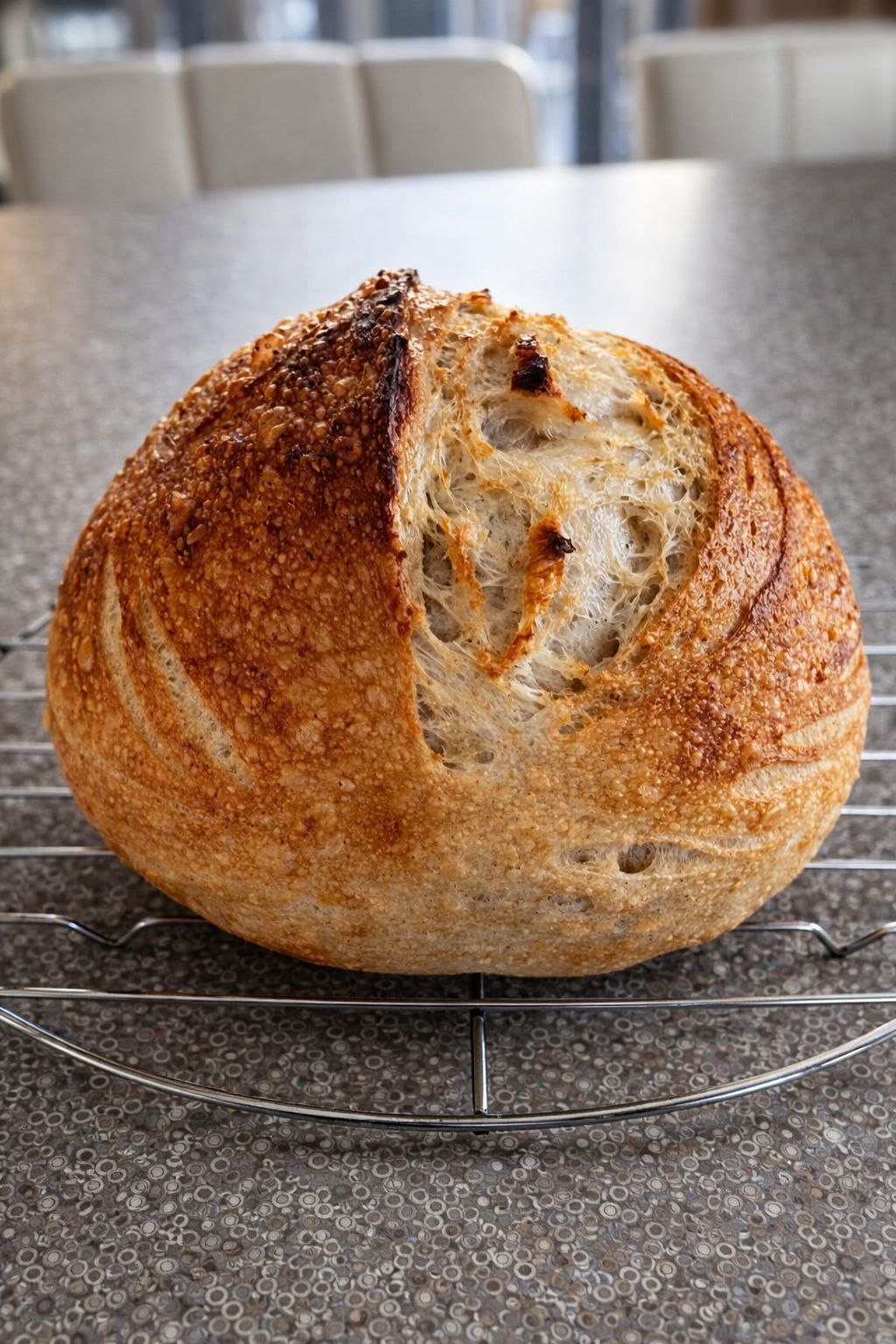
A No-Nonsense Guide for Serious Sourdough Bakers
Rewriting the Rules of Sourdough Bread Making
In the world of artisan sourdough baking, few techniques are repeated as religiously as autolyse. It is often presented as an untouchable rule: mix flour and water, rest, then add starter and salt. We challenge that narrative directly. Autolyse is not mandatory, and for many doughs, it is an unnecessary step that complicates an otherwise efficient process.
We demonstrate, with precision and clarity, that mixing flour, water, and starter all at once—while delaying only the salt—produces excellent sourdough bread with outstanding structure, flavor, and oven spring. This approach removes friction from the process, saves time, and delivers consistent results.
This is not theory. This is practical sourdough baking optimized for real-world kitchens.
What Autolyse Claims to Do—and Why It’s Overstated
Autolyse is traditionally described as a resting period that allows flour to hydrate, enzymes to activate, and gluten to begin forming naturally. While these effects are real in isolation, they are not exclusive to autolyse.
When starter is added from the beginning, the same hydration and enzymatic activity occurs—often more efficiently. Mature sourdough starter already contains active enzymes and acids that accelerate gluten development and dough conditioning.
The idea that autolyse is essential is an exaggeration.
The Core Truth: Starter Does Not “Ruin” Autolyse
A persistent myth claims that adding sourdough starter early interferes with gluten formation. In practice, this is false for most home and artisan baking scenarios.
A thick, mature starter strengthens the dough matrix rather than weakening it. The fermentation activity enhances extensibility, improves crumb structure, and contributes depth of flavor without requiring a separate flour-water rest.
What actually matters is salt timing—not starter timing.
Why Delaying Salt Still Makes Sense
Salt tightens gluten and slows fermentation. Adding it later allows the dough to remain extensible during early development.
By mixing flour, water, and starter together immediately, then adding salt after 20–30 minutes, we achieve:
- Faster dough cohesion
- Improved gluten alignment
- Smoother stretch-and-folds
- Reduced overall mixing time
This method preserves the only real advantage of autolyse while eliminating its inefficiency.
Optimized Ingredient Formula for High-Performance Sourdough
🍞 Ingredients
- 420 g white enriched flour
- 80 g whole wheat flour
- 120 g mature sourdough starter (thick consistency)
- 355 g chlorine-free water (cool to warm)
- 10–11 g fine salt
This balanced formula supports strong gluten development, controlled fermentation, and a crispy crust with an open, tender crumb.
Streamlined Sourdough Method Without Traditional Autolyse
1. Mix Everything Except Salt
Combine both flours, water, and mature starter in a large bowl. Mix thoroughly until no dry flour remains. The dough should appear shaggy but fully hydrated.
2. Rest Briefly
Allow the dough to rest for 30 minutes. This rest performs all necessary hydration and early gluten formation—without a separate autolyse step.
3. Add Salt
Sprinkle salt evenly over the dough. Incorporate by pinching and folding until fully dissolved and cohesive.
4. Bulk Fermentation
Cover and ferment at room temperature. Perform 3–4 stretch-and-fold sets during the first 2–3 hours. Continue bulk fermentation until the dough is airy, elastic, and approximately doubled in volume.
5. Shape with Precision
Shape gently into a boule or batard, preserving internal gas. Place seam-side up in a floured banneton.
6. Proof for Flavor Control
Proof at room temperature for 2–4 hours or refrigerate overnight for deeper acidity and improved scoring control.
7. Bake for Maximum Oven Spring
Bake in a preheated Dutch oven at 450°F (232°C) for 30 minutes covered. Uncover, reduce heat to 400°F (204°C), and bake an additional 15–20 minutes until deeply golden.
8. Cool Completely
Allow the loaf to cool fully before slicing to set the crumb and stabilize moisture.
Dough Performance: What Bakers Actually See
This method consistently produces:
- Strong yet extensible dough
- Predictable fermentation
- Excellent oven spring
- Even crumb with natural variation
- Deep, balanced sourdough flavor
The absence of a traditional autolyse does not reduce quality. In many cases, it improves workflow and consistency.
Why This Method Works Better for Modern Bakers
Modern flour, active starters, and controlled fermentation environments have changed sourdough baking. Techniques must evolve accordingly.
This approach:
- Removes unnecessary steps
- Reduces total hands-on time
- Improves reproducibility
- Simplifies teaching and scaling
- Aligns with enzyme-active fermentation
Efficiency and quality are not opposites.
Debunking the Autolyse Obsession
Autolyse is not harmful—but it is over-prescribed. Treating it as mandatory limits experimentation and discourages bakers from optimizing their workflow.
Sourdough baking thrives on understanding dough behavior, not blindly following tradition.
This method respects the science while prioritizing results.
Final Perspective for Sourdough Enthusiasts
We advocate baking methods that are practical, repeatable, and grounded in results. Eliminating unnecessary autolyse steps simplifies sourdough baking without sacrificing quality.
Mixing flour, water, and starter together from the start—while delaying salt—delivers everything autolyse promises, and more.
One less step. Same or better bread.